
Viognier For Me. Mango Juice For Her
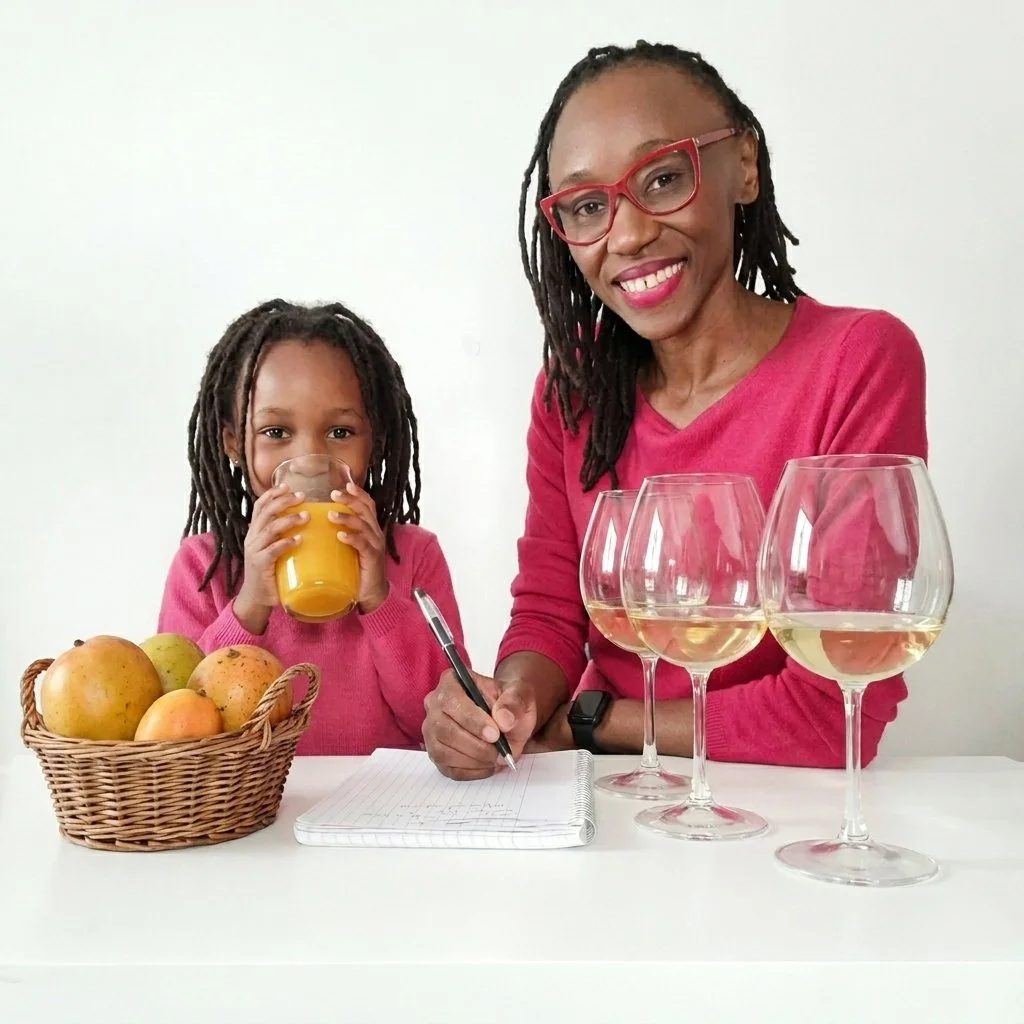
Kenyan wine consultant Mulongo and her mini me at the tasting table — Viognier in hand, freshly pressed mango juice for her. Ariège, France, May 2026.
📖 Read Time: Approx. 5 minutes
How your childhood table is the best wine education you never knew you had
The day I understood my own palate
My mini me stopped by to say hi and she came with her drink of choice. Freshly pressed mango juice. Naturally.
And standing there looking at her, something clicked.
Most people ask how I got into wine. How I learned to taste, to cook, to work with spice. Here is a piece of me that most of you don't know.
Growing up in Kenya, my mum made fresh mango juice depending on the season. And here's the thing. Mangoes in Kenya aren't just mangoes. They have names. Personalities. Purposes.
The Mangoes of Kenya · A Field Guide
| Ngowe | Slender, fiberless, intensely fragrant. The juice mango. You could smell it before she'd even cut it. |
| Apple Mango | Rounder, sweeter. Also for drinking. Different from the Ngowe — you knew it even as a child. |
| Kent & Van Dyke | Firm flesh, less sweet. Sliced into a shrimp salad or blended into a vinaigrette. The cooking mango. |
| Keitt | The late season arrival. Almost forgotten — until suddenly it wasn't. |
| Sabine | Fibrous, a little wild. The nostalgic one. One bite and you're back. You're always back. |
Mulongo Wine & Spice · Personal Notes · Kenya
The Ngowe and the Apple Mango — fragrant, fiberless, sweet. Perfect for juice. The Kent and Van Dyke — firm, sliced into a shrimp salad or blended into a vinaigrette I still make to this day. The Keitt when it was late season. The Sabine is fibrous, nostalgic. The one that takes you straight back.
"She knew which one for what. Without ever calling it pairing, that's exactly what she was doing."
Mulongo Binti Simiyu · Mulongo Wine & Spice
And without knowing it, I was learning.
You don't think anything of it then. You just drink your juice.
But here I am now — sampling wines, studying herbs and spices, building a whole life around flavour, realising I was never supposed to find this world.
I was already in it.
When I look at her with her mango juice, I think about that girl I was. Curious. Watching. Absorbing everything without knowing why. It also explains why I have a deep fondness for aromatic grapes like Viognier — all stone fruit, florals, peach and apricot. Those flavours were never new to me. They were always familiar.
Your palate already exists. It was built at your table.
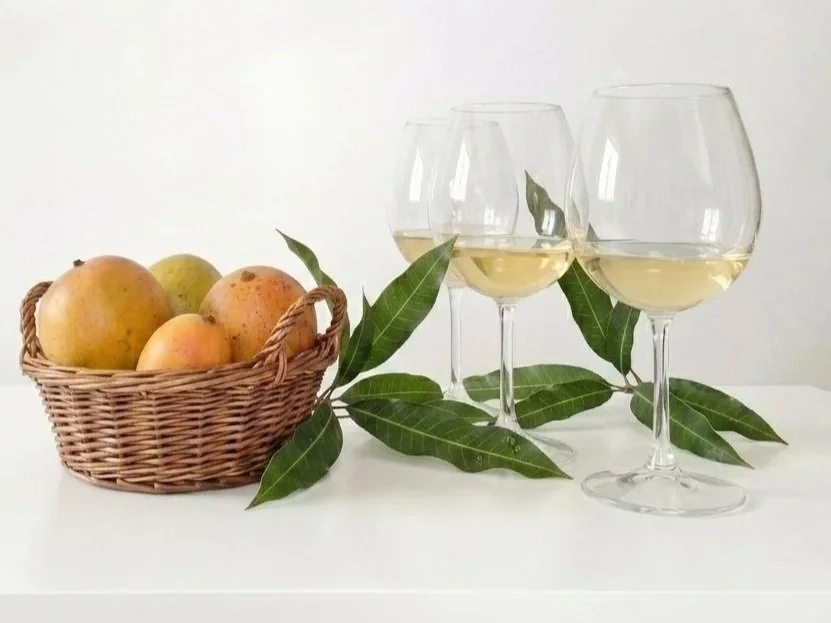
Three glasses of Viognier beside a basket of fresh Kenyan mangoes with mango leaves — the tasting table that started it all.
Here is what I want you to understand and this is the heart of everything I do at Mulongo Wine & Spice.
Learning to appreciate wine does not begin in a tasting room. It does not begin with a textbook or a qualification, though those things have their place. It begins somewhere far simpler and far more personal.
It begins at the table.
Very often, our palate is quietly shaped long before we are aware of it. By our environment. By the dishes our mothers made. By the herbs that grew in the garden. By the spices that lived in the kitchen cupboard. By the fruits that came with the season.
This is why I always tell people. Before you reach for a wine book, reach for your own memory.
What did you grow up eating? What herbs were always present? What did your family cook on Sundays? What fruit did you eat straight from the tree? What did your grandmother put in everything?
Those answers are not just nostalgia. They are the blueprint of your palate.
You don't have to go far. Start at home.
One of the greatest myths about wine education is that it requires distance from yourself. That you must learn a new vocabulary, a new set of references, a whole new world of flavour before you can begin to understand what is in your glass.
I disagree entirely.
The herbs and spices and meals that grew around you — that were made for you, eaten with you, remembered by you — those are your reference points. Those are your anchors. And they are as valid as any tasting note written in any classroom.
A Kenyan who grew up with fresh mango, tamarind, sweet potatoes and coconut rice already has a sophisticated palate. They just haven't been told that yet.
A French child who grew up at a table with thyme, mustard, slow-braised meat and sharp aged cheese already understands structure, depth and complexity. They just haven't applied it to wine yet.
You do not need to build a palate from scratch. You need to recognise the one you already have.
How to begin — practically
Start with what you know. Think about the dominant flavours of your childhood table. Were they sweet, tangy, smoky, herbal, spiced, rich? That tells you something immediately about where your palate feels at home.
Then find wines that speak that language. If you grew up with aromatic, fragrant food. Look at Viognier, Gewurztraminer, Torrontés. If your table was built on earthy, herbal, savoury flavours. Explore Grenache, Sangiovese, aged Rioja. If citrus and freshness defined your meals. Try Albariño, Vermentino, Picpoul.
The connection between your food memory and your wine preference is not accidental. It is deeply personal and deeply logical.
Two young African girls. One still becoming. One just beginning.
"It was always the table, darlings. It was always the mango juice. The answer was there all along — right there in my childhood."
Your palate is not something you acquire. It is something you remember.
It lives quietly in your subconscious, shaped by every meal, every season, every hand that cooked for you. And with a little attention — a little curiosity — you can learn to master it.
You already have everything you need. You just need to come back to the table.
Do you remember when your love of food first began? Does it shape the way you drink wine today?
Drop a 🥭 in the comments if you have a food memory from childhood that you never connected to your palate until much later. I want to hear yours.