
France 2026: The Vintage That Wouldn't Wait

Early fruit set on a grapevine in Ariège, southern France, May 2026.
📖 Read Time: Approx. 5 minutes
France's 2026 vintage is already rewriting the rules. And the vines are blooming weeks ahead of schedule to prove it.
Here I am, darlings — standing in the vines in early May, and we are already at fruit set. The flowering has come and gone. Not in late May, as tradition would have it. Not edging into June. Already done, already behind us. This is 2026, and French viticulture is navigating a new season with entirely new rules.
I'm watching the vineyard from a hillside in Ariège, where the Pyrenees frame the horizon and the air still carries a chill that doesn't quite match what the vines are telling me. Bud break came early. Flowering followed faster than expected. And now, in a May that feels like it's borrowed time from July, the tiny berries are already forming. After the heavy rains and flooding that moved through this region, you start to ask yourself: what exactly is this vintage going to become?
It is a question producers across the whole of France are asking right now. And the answer, like the weather itself, is anything but simple.
A Growing Season That Won't Follow the Calendar
France's wine calendar has always been anchored in seasonal rhythm. The slow unfurling of budburst in spring, the quiet miracle of flowering in early summer, the patient wait for harvest. But in 2026, that rhythm has accelerated dramatically. Wine journalist Jane Anson, reporting from inside Bordeaux's primeurs circuit, noted that the 2026 budding cycle is tracking two to three weeks ahead of the historical average. A staggering leap forward, even compared to 2025, which was already one week early.
What does that mean, practically? Each year, the clock ticks forward a little faster. The vines are waking up earlier, flowering sooner, and pushing the entire growing season into territory that maps to no historical precedent.
From where I'm standing in Ariège, in the shadow of the Pyrenees, this feels visceral. Not abstract. Not a statistic. Real. The vines outside are doing something they weren't supposed to do for another six weeks.
weeks
weeks
The Rain, the Flood, and the Mildew Question
Early budding and flowering aren't inherently catastrophic in a perfect world, they simply mean an earlier harvest. But here's the complication: France has also been dealing with serious rainfall events this year. And rain, combined with unseasonably warm temperatures and early vine growth, creates a near-perfect storm for disease.
Downy mildew is the villain of many recent French vintages. Disease pressure appeared much earlier than in previous seasons, with some growers starting to spray at the beginning of April, far earlier than the traditional window. In 2024, the pattern was already devastating, with some estates looking at losses of 60 to 65 per cent.
In Occitanie and Languedoc, the Pyrenees shadow creates its own microclimate , drought on one side, excess humidity on the other. This is not new. But it is intensifying. The swing from heavy rain to hot, humid days — the precise sequence I've been living through here in Ariège — is exactly the cycle that accelerates fungal disease in the vineyard.
For organic and low-intervention producers in particular, the challenge is acute. Protective sprays wash off. Windows to re-treat are narrow. And the warm-cold oscillations that have defined this spring make forecasting nearly impossible.
I don't know a single winegrower who doesn't believe in climate change. They have to live with global warming on a daily basis.
What the Science Has Been Telling Us
The acceleration visible in French vineyards today is not sudden, it has been building for decades. Every stage of a vine's growth and development has started earlier than before. Harvests have been taking place on average three weeks earlier than in the 1980s.
Research published in the scientific journal OENO. One found that increased temperatures are speeding up grapevine development, favouring flowering, and inducing more heat damage across all wine regions — especially under Mediterranean climate conditions. For the south of France, including Occitanie, higher water deficit stress combined with elevated temperatures is identified as the dominant future risk.
A NASA-supported study tracing 400 years of European harvest data confirms that the shift is not cyclical, not temporary. The large-scale climate drivers that local factors operate under have shifted — and what we are witnessing right now, in these May vines, is not an anomaly. It is a new normal arriving faster than the industry had planned for.
How Producers Are Adapting — and What It Costs
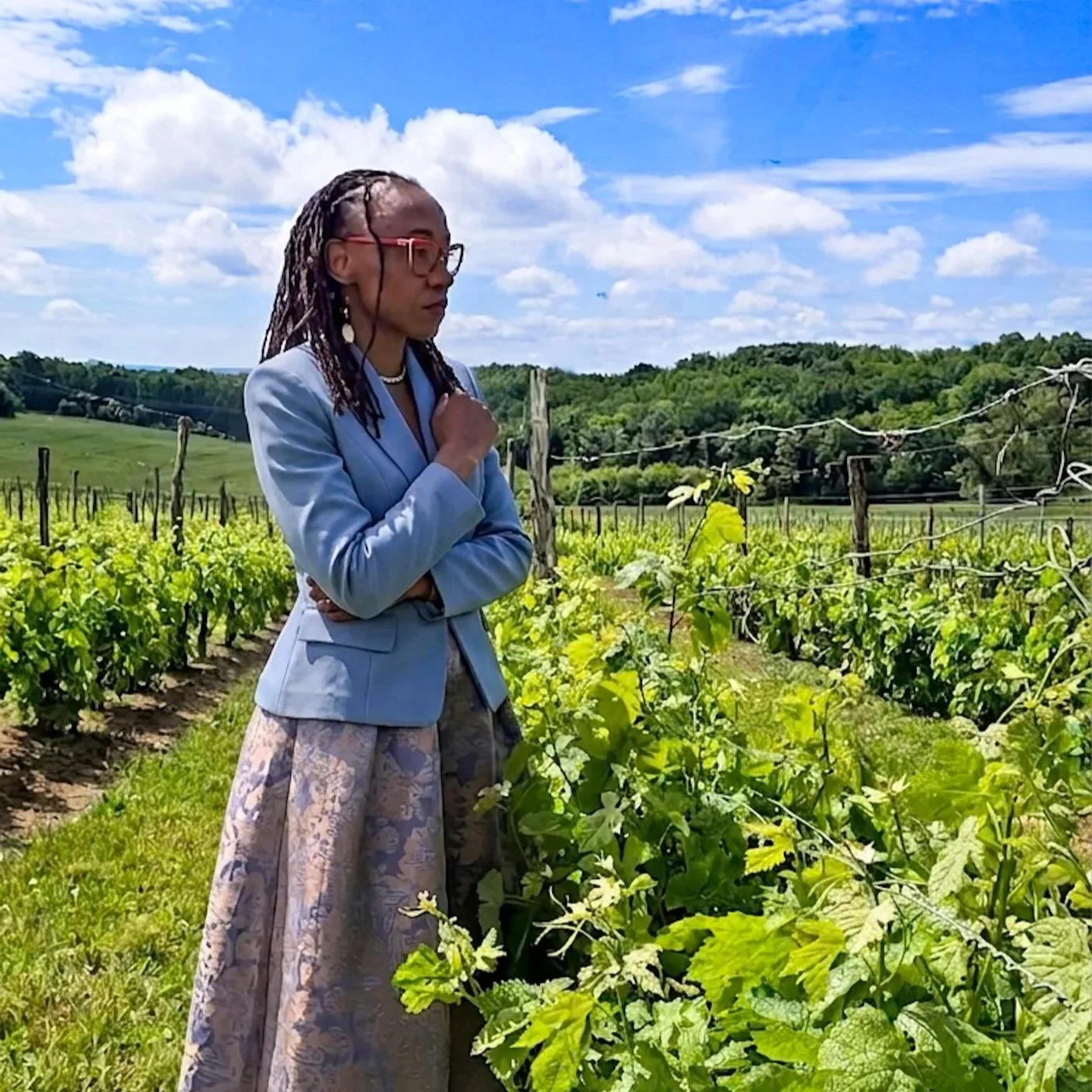
Wine consultant and blogger Mulongo in the vineyards of Ariège, France, May 2026.
There is no single solution. The adaptation strategies being deployed across France are varied, creative, and expensive — and there is no guarantee any of them will be enough in the long run.
The wine industry has been adapting in four key ways: changes to winemaking methods such as adding acids to adjust pH; altering farming practices by applying more irrigation or shade; planting vines in rows not in direct sunlight; and replanting vineyards in new locations. But researchers add an important caveat — there are limits to adaptation. The potential is real, but it is not infinite.
Among the most compelling responses is a return to viticultural diversity. In the past, growing a multitude of grape varieties — all with different characteristics — allowed production to continue in the face of frost, drought and heatwaves. Some producers are now reviving ancient Alpine grape varieties, with seventeen already reintroduced into France's national catalogue. Others are rethinking harvesting windows, fermentation temperatures, and even appellation rules. The conversation is wide open and it is urgent.
The 2026 Vintage: A Story Still Being Written
No one can tell you yet what the 2026 vintage will taste like. The vines are still flowering. The summer is still ahead. Harvest is weeks away. But standing here, watching the early blooms against a sky that can't quite decide between warmth and storm, I feel the weight of the question.
What strikes me most is not the fear. It's the tension between what the vine remembers and what the climate demands of it. The vine is ancient. It has adapted before. But it has never been asked to adapt this fast.
For the producers of Ariège, of Languedoc, of the whole south of France: this growing season asks everything of them. Vigilance. Flexibility. Courage. And the willingness to question assumptions that have held for generations.
I will keep watching. I will keep asking. And I will keep telling you what I see — from the vines, from the glass, from this extraordinary corner of France where the Pyrenees meet the vine.
How is global warming changing the wine in your region — and what do you think producers should do to adapt?
Leave your thoughts in the comments — I'm reading every one.
With curiosity and a glass of something cold,
MulongoMulongo Wine & Spice · Ariège, France ✦