
How a Christmas party, a village mayor and a family winery gave a Spanish grape a new home in Rheinhessen.
📖 Read Time: Approx. 7 minutes.

Tasting the 2025 Tempranillo from Weingut Stefan Lutz in Bechtolsheim, Rheinhessen, on International Tempranillo Day.
I never studied German, yet Germany has fascinated me since childhood.
At school I studied English, Swahili and French, with a little Spanish along the way. But I have always loved reading folktales from around the world, and that is how Germany found me, through the Brothers Grimm, from Hansel and Gretel to Snow White. I realised that Germany, just like Kenya, has its own folklore, with stories handed from one generation to the next.
Years later, travelling gave me another way in: through its wines. Everyone knows the big names, Mosel, Rheingau and the Rieslings that put Germany on the world's wine map. But I fell properly in love with German wine during my DipWSET studies, and what a ride that was.
Learning to pronounce regions, grapes and producers I could hardly say was part of the charm. (Trockenbeerenauslese, anyone?) In blind tastings I would often know exactly what was in my glass, then struggle to spell it and wince at my own mistakes. It was sad and funny at the same time, and deeply rewarding to get the wine right. If you have wrestled with those wild German names too, you're in good company.
So when the team at Weingut Stefan Lutz got in touch to offer me a sample of their wines, I was honoured. What a privilege to taste them and share my impressions, and the wine delivered, and more.
On International Tempranillo Day, most of us look to Rioja or Ribera del Duero. I'm looking to Rheinhessen, in Germany. Yes, really. A Spanish grape grows on the slopes of the Petersberg in Bechtolsheim, and it surprised me from the first sniff. It comes from Weingut Stefan Lutz, a family estate now in its third generation, whose label calls the wine a Prachtkerl, a splendid fellow. I tasted it with my notebook open and kept coming back to the glass. Here is how it came to exist, and why it deserves a place in the Tempranillo conversation.
A Christmas party, a mayor and a Spanish grape
Every good wine has an origin story, and this one begins at a Christmas party.
Several years ago, Stefan Lutz was talking with a good friend, Dieter Mann, who was then the village mayor and also a winegrower. Dieter had done something unusual for the region: he had planted Tempranillo. The vines went in on the slopes of the Petersberg in 2019, and the first harvest followed in 2023.
Stefan was immediately curious. Tempranillo is best known for the powerful, structured reds of Rioja and Ribera del Duero, but why shouldn't it develop a personality of its own in Rheinhessen?
The early vintages were small. The first yielded around 500 bottles and 2024 around 1,200. The grapes still came from Dieter's vineyard, while Stefan looked after the winemaking, from fermentation to bottling. When Dieter decided to retire from winegrowing, Stefan took over the vineyard. A conversation between two friends had become a very personal project.
Not a Spanish wine in Germany
The 2025 is the first Tempranillo made entirely under the estate's own responsibility, with about 2,600 bottles. And Stefan made a deliberate choice: he did not want to imitate Spain.
Traditional Spanish Tempranillo is often valued for power, concentration, firm structure and sometimes pronounced oak. Stefan wanted to see what the grape could do in Germany, so he went for a fruit-forward, lighter and more elegant style, with soft tannins, preserved freshness and oak that supports the wine instead of dominating it.
In his words: “I didn't want to make a Spanish wine in Germany. I wanted to discover what this wonderful Spanish grape could become on Rheinhessen soil, with our fruit, our freshness, and a personality entirely its own.”
That is exactly what I found in the glass.
In the vineyard and the cellar
The vines grow on the slopes of the Petersberg, just below a local viewpoint called the “Tisch des Weines”, the Table of Wine. The soils are deep loess-loam. Loess is wind-blown silt, and it holds water and nutrients well, which matters in warm, dry summers because the vines can draw on moisture stored in the ground.
Rheinhessen is one of Germany's warmer, drier wine regions, and its long, sunny seasons suit a demanding red grape like Tempranillo. The skill lies in the picking date: ripe enough for integrated tannins and expressive fruit, early enough to keep the freshness that makes the wine so easy to drink.
The 2025 grapes were picked in late September and fermented on the skins, which extracts colour, aroma and tannin. Malolactic fermentation followed in stainless steel tanks, turning sharp malic acid into softer lactic acid for a rounder texture, and the wine then matured in a combination of American and German oak barrels.
Restraint mattered most here. Stefan says the interplay between the two oaks adds a delicate touch of vanilla that complements the vibrant fruit and gives the wine an extra layer of elegance and complexity, without overpowering its character. In the glass, it shows as a touch of oak and nothing more.
In the glass: my tasting note
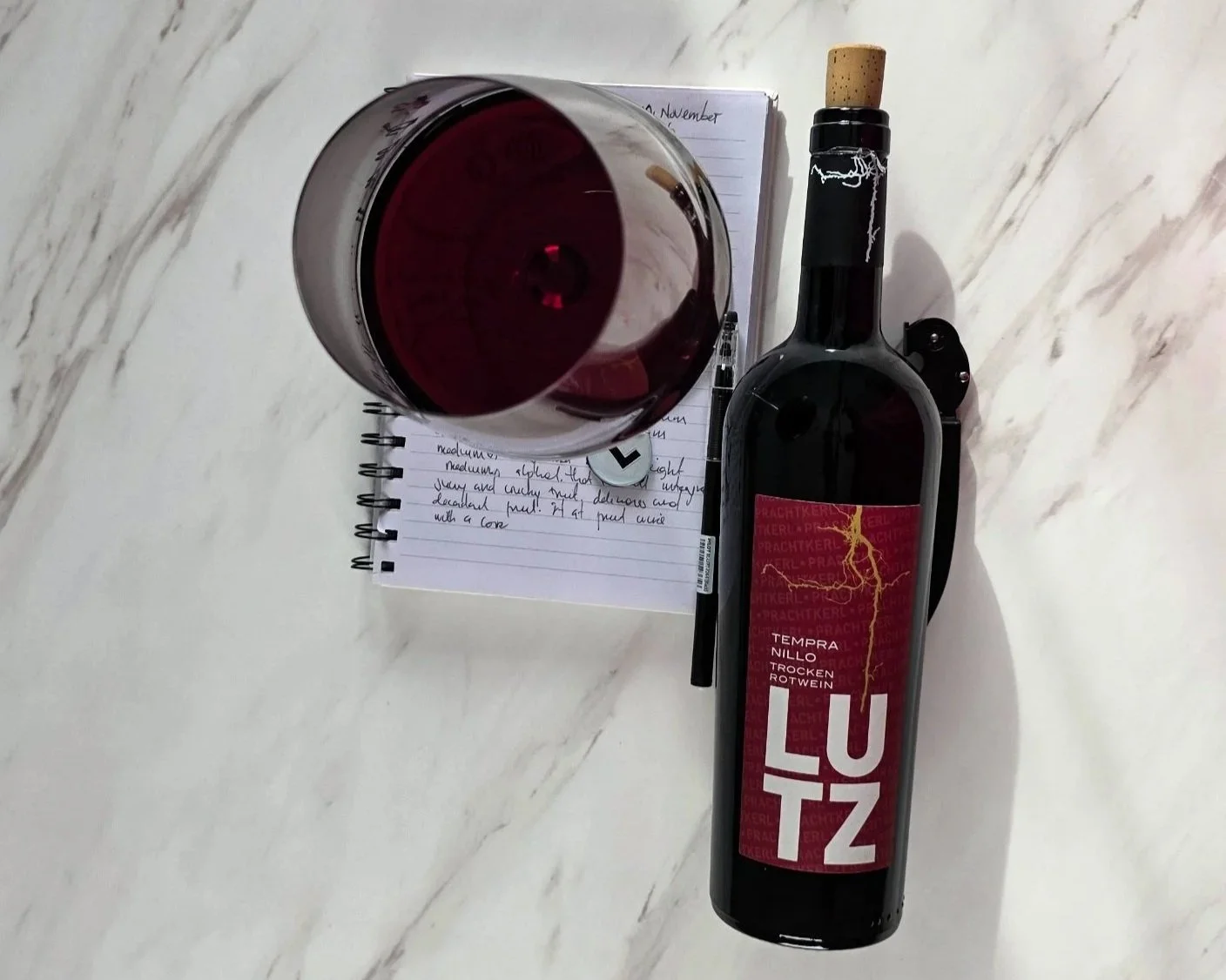
The notebook open beside the 2025 Tempranillo, ready for the tasting note.
Appearance: ruby, a beautiful, clear colour.
Nose: pronounced and fresh: blackcurrant, raspberry, strawberry and blueberry. It then opens to floral notes of violets and red roses, and evolves to black pepper, a touch of toast and vanilla, with undergrowth and wet stones in the background.
Palate: bone dry, with medium acidity, medium (+) tannins that are supple, round and ripe, and medium to medium (+) body. Medium alcohol: the 13.5% on the label is not felt, it is so well integrated. Crunchy, juicy fruit, like biting into fresh raspberries, cranberries and black cherries, with black pepper, violet and rose coming forward.
Finish: medium (+), lingering on fruit.
Conclusion: outstanding quality. A tamed Tempranillo, fresh, fruit-driven and perfectly balanced, in a different style from Spain.
Drinking window: ready to drink now. I believe a little bottle age will bring out lovely tertiary notes.
The fruit is the core of this wine. It is what you notice first and what stays with you at the end. I kept sipping, and kept thinking about it long after.
Why “Prachtkerl”?
The label repeats the word across its background, so I had to ask. There is no centuries-old legend behind it, Stefan told me, just a little Rheinhessen humour. They wanted a friendly, slightly unconventional label for a grape that is still unusual in the region.
Prachtkerl is hard to translate perfectly. It is an affectionate, playful word for a splendid fellow, someone with charm, personality and a certain confidence. After tasting the wine, I think it suits it rather well.
A landscape with a long memory
Stefan also reminded me that this land has a long memory. People have lived around Bechtolsheim for thousands of years, and the Romans left their mark on this part of Rheinhessen too. “We cultivate soils whose history extends far beyond that of our own family,” Stefan says. The family's roots travel as well: their ancestors came from France to Germany through Alsace, and Stefan likes the thought that an openness to different wine cultures may have been part of his family story for a very long time. A Spanish grape in Rheinhessen, interpreted by a family with French roots, does feel like coming full circle.
What I would put on the table
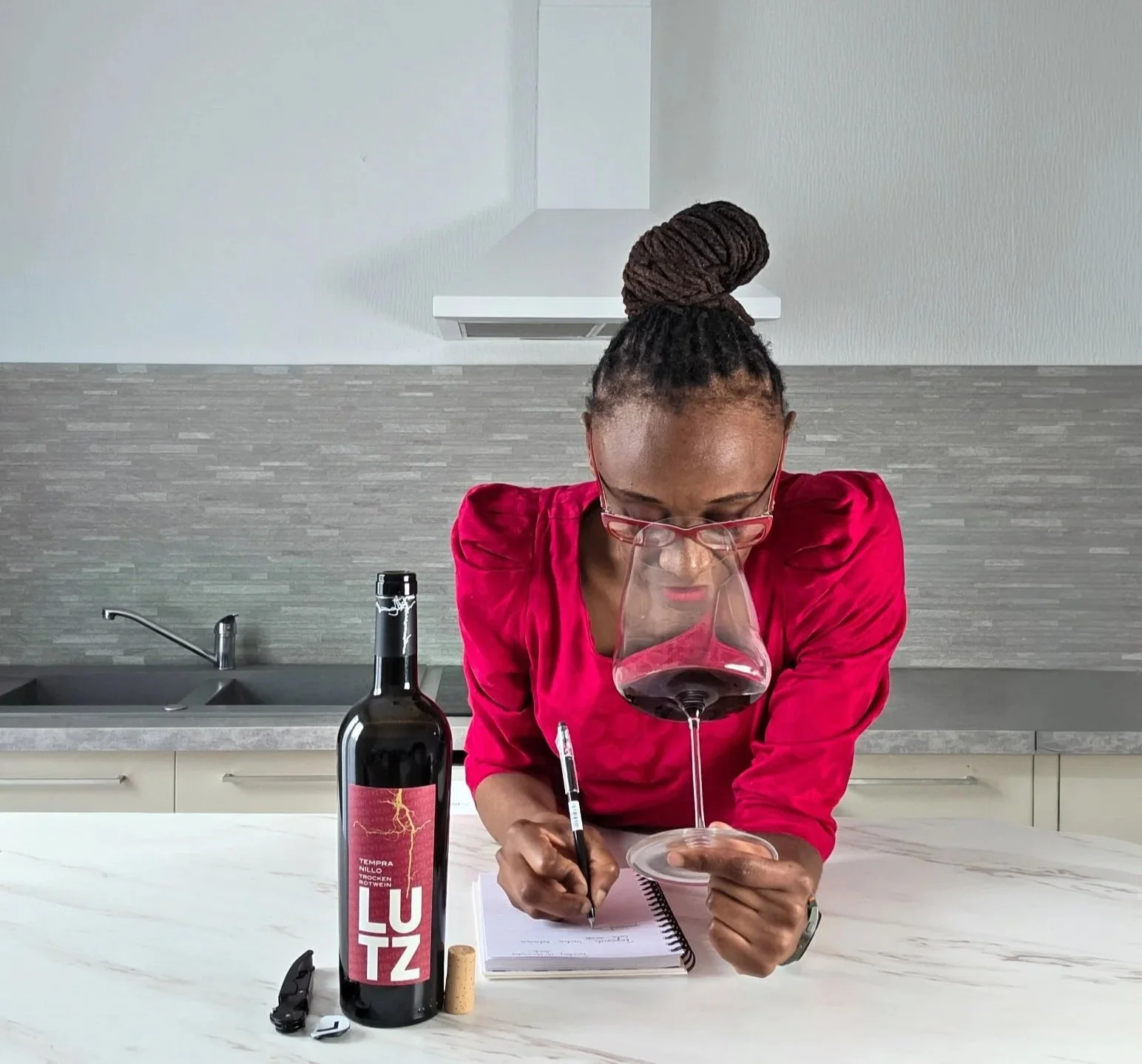
Nosing the wine and taking notes: pronounced and fresh, with berries, violets and a touch of vanilla.
I build dishes note by note from a wine's tasting profile, and this wine gives plenty to work with. Chicken or grilled vegetables suit it well. For something more indulgent, here is the plate I would build:
Duck breast rubbed with cumin, cardamom and black pepper, with a pinch of clove and cinnamon. The richness of the duck softens the tannins, and the pepper echoes the spice in the wine.
Spiced lentils simmered with roasted coriander seeds, cumin and garlic in a tomato sauce. Their earthiness mirrors the violets and undergrowth in the glass, the tomato's gentle acidity echoes the wine's freshness, and a spoonful of full-fat yoghurt adds a cool contrast.
A tamarind pan sauce to echo the dark fruit and cut through the richness.
A small production with a bigger story
Stefan has no plans to mass-produce this wine. The 2026 harvest is expected to yield about 2,600 bottles again, so the Tempranillo will stay a small, special part of the estate's range, a place to keep exploring what the grape can become.
For him it has become much more than an interesting addition. It stands for friendship, the joy of trying unusual ideas, and attachment to home. “Sometimes the story of a special wine doesn't begin in the vineyard or the cellar,” he says. “Sometimes it begins with a good conversation between friends.”
I couldn't agree more. Stories, like wine, tend to start with people around a table.
Have you ever tried a Tempranillo from outside Spain? Tell me where it was from in the comments.
Stay curious, darlings.
Taste. Think. Taste again.
Wine kindly sent by Weingut Stefan Lutz. Tasting notes and opinions are my own.