
Bubbles of Joy: Celebrating Cap Classique Day with Pongrácz Brut
A Kenyan wine lover's toast to the sparkling wines of South Africa
📖 Read Time: Approx. 4 minutes.

Mulongo pours a glass of Pongrácz Brut, the South African Cap Classique she's toasting with this Cap Classique Day.
Back in the early 2000s, as a student in France, I thought I knew sparkling wine. Crémant, Champagne, that was the whole map as far as I was concerned. What I didn't know then was that my fellow Africans down south were already crafting something just as beautiful.
Growing up, I'd learned about South Africa in school: the geography, the history, the facts you memorize for an exam. The wine wasn't part of that picture. And what little of it reached us in the early 2000s was mostly mass-produced, the kind of bottle you'd grab off a supermarket shelf without a second thought.
It's been a joy watching that change. The good stuff is finding its way to us now, and Pongrácz is one of the reasons why.
The bottle in my glass this year is the Pongrácz Brut: 60% Pinot Noir, 40% Chardonnay. Hand-harvested along the Cape between January and February, then left on the lees for two years before disgorgement. Green apple and citrus on the nose, a creamy mousse, and a finish that lingers with toast and ripe fruit. It's the kind of glass that makes the case for CC without needing to say a word.
What is Méthode Cap Classique?
CC is South Africa's answer to Champagne, made the same traditional way: aged on its lees, refermented in the bottle, built for fine bubbles and creamy texture and lively acidity. First pioneered in 1971 by Frans Malan of Simonsig, it's grown into something more than a style. It's proof that African soil produces world-class wine, and that African winemakers have earned their seat at the table.
A new generation is carrying it forward, including Black-owned labels like House of Mandela, Klein Goederust, Bosman Family Vineyards, and Kumusha Wines, reshaping what the world expects from South African wine.
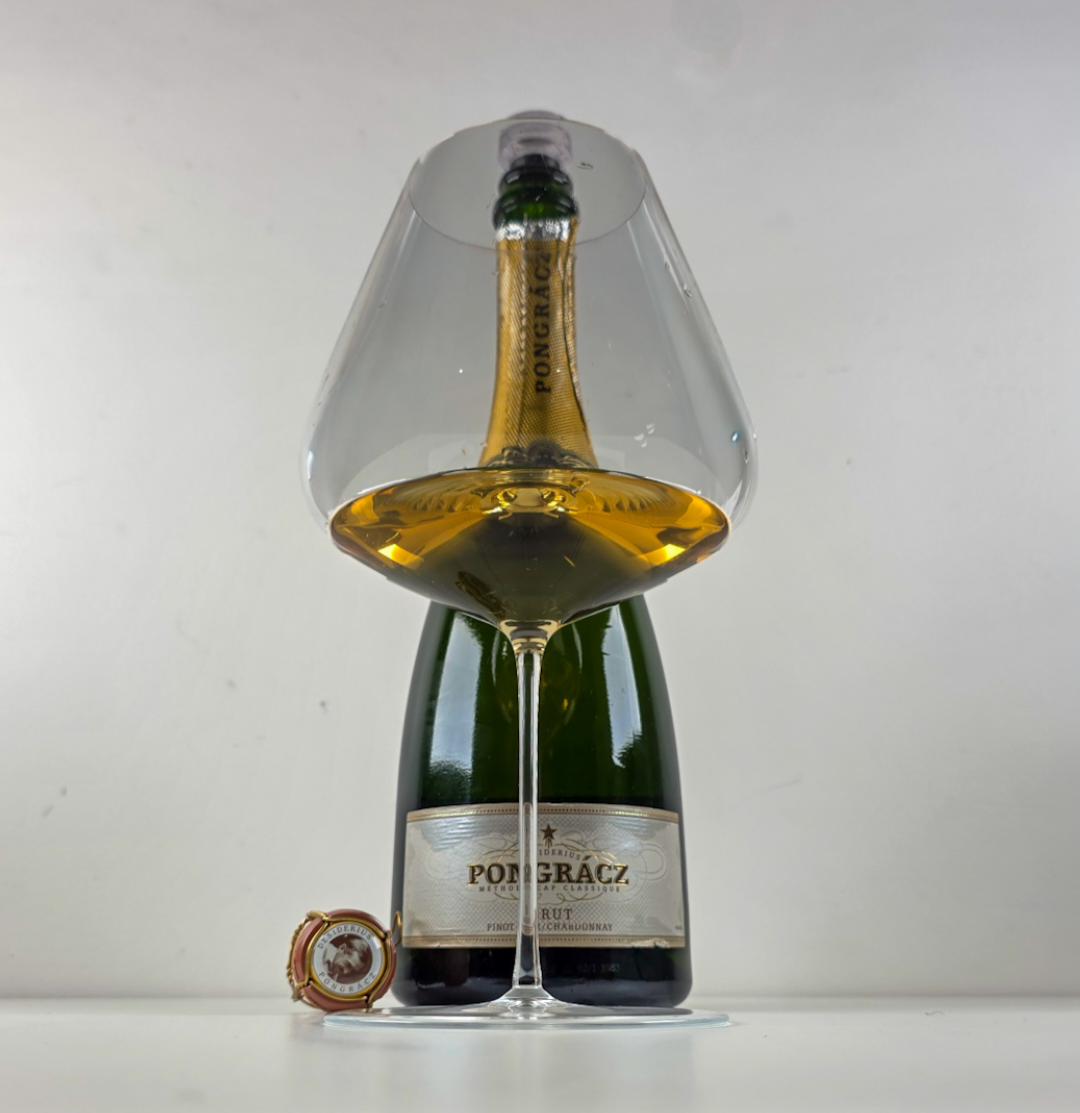
A quiet still life of the Pongrácz Brut bottle and glass, two years on the lees before disgorgement.
CC and the East African Table
In my work as a wine educator, I've come to believe African cuisine is criminally underrated, often seen only through a lens of scarcity when the truth is richer than that. There's real hunger and inequality on this continent, that's not something to gloss over. But there's also a food culture built on flavour, seasonality, and community, and that deserves just as much attention.
I cook from the coast of Kenya: tamarind, coconut, chili, citrus. And CC pairs with it beautifully. Its acidity cuts through a rich coconut sauce, its bubbles lift the spice instead of fighting it, and its texture sits well against grilled fish or a plate of fritters still warm from the pan.
My Philosophy: Food, Wine and Love
People ask why I focus on simple ingredients, why I teach wine in places wine isn't usually seen as accessible. The answer is that love belongs at every table, not just the ones with caviar on it.
I champion affordable, everyday recipes using local ingredients because that's where the real magic lives. A perfectly ripe tomato. A handful of pili pili. A spoon of coconut oil. Made with love, and it becomes something worth celebrating.
Just like wine. Just like CC.
When I see something beautiful coming from anywhere on the continent, I feel proud to celebrate it, because when one of us wins, we all win. Cap Classique may be South African, but you have no idea how wonderful it is to say a fellow African is taking wine, culture, and heritage to new heights. For that, I'm grateful. This is an ode, from this curious wine-eyed Kenyan, to my South African family.
This Cap Classique Day, I Invite You To:
🥂 Raise a glass of Cap Classique, and support South African producers, especially Black-owned and women-led labels.
🍛 Make a dish with what you have: coconut milk, local greens, sweet potato, fish, or grain. Cook it with love, serve it with joy.
📚 Share the story. African cuisine isn't "ethnic," it's ancestral. And it pairs like a dream with a good glass of bubbles.
Darlings, let's keep pouring love into every glass, every dish, and every story.